
I’m blogging again, after a few years’ break, at narrowdesert.wordpress.com.
Blog terminated
This (here, now, you, me!) is a world in which religion is just grist to the mass media mill, marriage and family are grist to the media mill, our surface opinions and deepest convictions are grist…
We are all hack journalists now; thinking the thoughts and living the lives of hacks.
— Bruce Charlton (qv)
I have decided to stop blogging for the foreseeable future.
I have always been an infrequent poster, and in theory posting just a few times a month shouldn’t be all that different from not posting at all — but I nevertheless find that the very prospect of posting (even if hardly ever realized) affects how I think and live. I am, as Bruce says, thinking the thoughts and living the life of a hack. Publication has insinuated itself into my mind as the implicit goal of all thought, with the result that even my private reading, thinking, and pondering have become fundamentally unserious, interested more in being clever than in finding the truth.
I am, therefore, monk-style, taking a vow of mass-media silence. I will leave existing entries online, but nothing new will be added. Personal communication is of course still welcome; I can be reached at my gmail.com address, which is wiltyc.
So long, and thanks for all the fish.
Filed under Uncategorized
Christopher Hitchens misrepresents Dante
From God Is Not Great, pp. 167-68:
[O]ne of the great difficulties of revealed religion . . . is the problem of what to do about those who were born before the exclusive “revelation,” or who died without ever having the opportunity to share in its wonders. Christians used to resolve this problem by saying that Jesus descended into hell after his crucifixion, where it is thought that he saved or converted the dead. There is indeed a fine passage in Dante’s Inferno where he comes to rescue the spirits of great men like Aristotle, who had presumably been boiling away for centuries until he got around to them.
This is wrong on two counts.
First, despite Dante’s obvious admiration for the person he refers to as “the Philosopher” and “the master of those who know,” Aristotle is never saved. Neither is Virgil, nor any of the other virtuous pagans of pre-Christian times. Dante meets them in hell. He writes that he “still glories in having witnessed” such “great souls” — but nevertheless insists that they are damned. When Jesus descends to hell after his crucifixion, he saves only those who explicitly worshiped Yahweh while they were alive — i.e., the Hebrews of Old Testament times, plus one Trojan warrior who (according to Dante) had received a private revelation and become a secret Yahwist. Everyone else is permanently damned — unless, like the Roman emperor Trajan, they have the good fortune to be miraculously raised from the dead and converted on earth; in hell, conversion is to no avail.
Second, Aristotle and the others are not and never were “boiling away.” They are consigned to Limbo — which, while technically a part of hell, involves no torture, fiery or otherwise. Aristotle and company live, for all intents and purposes, in the very Elysian Fields for which they had perhaps hoped. Their only “punishment” is that they long for paradise but have no hope of ever attaining it. As for the virtuous Hebrews saved in Christ’s “harrowing of hell” (as his post-crucifixion visit is called), they did have a hope of eventually reaching paradise, and so for them Limbo involved no punishment whatsoever. They were never in “hell” at all in any meaningful sense.
So Dante’s God is both more and less merciful than Hitchens portrays him to be. More merciful, because he doesn’t actually torture or “boil” anyone for the “sin” of having been born at the wrong time; less merciful, because he does bar such people from paradise permanently.
For more details, see my post “The fates of non-Christians in Dante’s Comedy.”
Filed under Christianity
“Regular Joe” surnames
American:
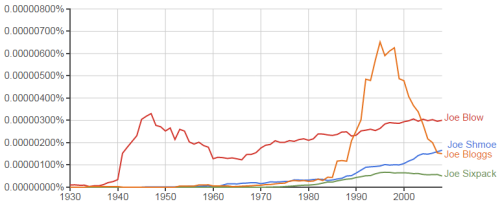
Mr. Blow has been the frontrunner all along, ever since generic Joes first rose to prominence and began to compete with generic Johns (Doe, Q. Public). Joe Bloggs enjoyed his quarter-hour of fame in the nineties but ended up falling as quickly as he had risen. Shmoe has always been my Joe of choice, so I’m gratified to see him gaining steadily, playing tortoise to Bloggs’s hare. If current trends continue, he’s set to surpass Blow within the next 10 years or so.
British:
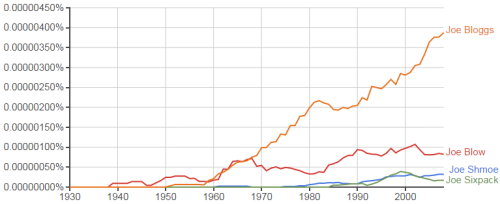
In Britain, on the other hand, Bloggs is unstoppable
Filed under Language, Silliness, Statistics
More synchronicity: Rivers of Babylon
Just after posting the previous post, I had a bit of free time, so I played the musical free-association game: I choose a song to start with and play it, and when each song ends, I play whatever comes to mind next — which will generally be related in some way. Here’s what I played this time:
- Frankie Valli and the Four Seasons, “Walk Like A Man”
- They Might Be Giants, “How Can I Sing Like A Girl?”
- The Bee Gees, “Stayin’ Alive”
- James Taylor, “Walking Man”
- Leonard Cohen, “By The Rivers Dark”
After that, the next song that came to mind was Don McLean’s “Babylon” — which, like the Cohen song, is based on Psalm 137. I wasn’t really in the mood for Don McLean, though, so I stopped the association stuff and just put iTunes on random shuffle. The third or fourth song it selected on random shuffle was — wouldn’t you know it? — Don McLean’s “Babylon.”
*
Less than an hour later, I picked up Krailsheimer’s Pascal again and found the following passage:
The rivers of Babylon flow, and fall, and carry away.
O holy Sion, where everything stands firm and nothing falls!
We must sit by these rivers, not under or in them, but above, not standing upright, but sitting down, so that we remain humble by sitting, and safe by remaining above, but we shall stand upright in the porches of Jerusalem.
Let us see if this pleasure is firm or transitory; if it passes away it is a river of Babylon.
A footnote explains, “This fragment is a paraphrase of a meditation on Ps. CXXVII [sic] by St Augustine.” All this happened just hours after I had written a post which quoted St. Augustine in connection with popular music (facetiously citing “noted Augustine scholar Sir Michael P. Jagger”).
Filed under Coincidence / Synchronicity, Music, Old Testament
Constitutive ends, transcendent ends, and rules
I don’t care about making money, I just love to sell carpet!
— Buddy Kallick
If you ask what the goal or end of a particular action is, there are a number of actions which admit of two distinct answers — which, after rejecting several even less felicitous terms (trust me, it’s possible!), I have decided to call the constitutive end and the transcendent end.
This distinction was brought to my attention as I was rereading some of the epigrams filed under “Diversion” in Pascal’s Pensées (Krailsheimer’s translation), so I might as well use one of his examples to explain what I mean.
[Those who say] that people are quite unreasonable to spend all day chasing a hare that they would not have wanted to buy, have little knowledge of our nature. The hare itself would not save us from thinking about death and the miseries distracting us, but hunting does so.
In this case, catching the hare is the constitutive end of the hunt — so called because such an end is an essential part of what makes a hunt a hunt. Without a hare (or some other quarry), there can be no hunt. Or, to be more precise, it is not the hare itself that is necessary so much as the idea of the hare, as a goal imagined in the hunters’ minds. It is quite possible to hunt even when there are no hares about, so long as the hunters do not know this.
The constitutive end is therefore absolutely necessary, in that the activity in question is by definition the pursuit of that end. Unless a person pursues that end, it is impossible for him to engage in that activity. However, psychologically, it often happens that the constitutive end is not the “real” end — not the thing that would really satisfy those who are ostensibly pursuing it. This is where transcendent ends come into play. (Sorry if that sounds a little too maharishi; again, you’ll just have to trust me when I say that these are the least infelicitous terms I could come up with.) In Pascal’s example, the transcendent end of the hunt is simply to distract the hunter, thus relieving him of the pain of thinking about our miserable human condition. I call it transcendent because it transcends the activity itself. The hunt as a hunt is perfectly intelligible on its own terms even without the knowledge that the hunters are seeking to be distracted from their own mortality — but not without the knowledge that they are pursuing a hare.
*
Furthermore, although the transcendent end is the “real” end — the one that the hunters actually care about — they must nevertheless focus all their attentions and energies on the constitutive end. In another of his examples, Pascal discusses a man who gambles a small sum every day for entertainment. Like the hare hunters, he doesn’t really want his ostensible goal (money) but rather diversion and distraction. If you offered to just give him some money each day on condition that he give up gambling, he wouldn’t be interested. However —
He must have excitement, he must delude himself into imagining that he would be happy to win what he would not want as a gift if it meant giving up gambling. He must create some target for his passions and then arouse his desire, anger, fear, for this object he has created, just like children taking fright at a face they have daubed themselves.
The transcendent end is such that it cannot be pursued directly, but only by means of the pursuit of a wholly different (constitutive) end. And the more you can lose yourself in the pursuit of the CE, forgetting all about the TE if possible, the more likely you will be to attain the TE.
*
Actively pursuing one end (the CE) in order to attain a quite different end (the TE) is a dicey business, since there will nearly always be actions which, while effective ways of reaching the CE, are actually detrimental to the TE. This is why it is often necessary to pursue the CE within a framework of rules.
Hunting, for example, is subject to standards of sportsmanship, and too-effective methods are deemed unsportsmanlike. This is very strange if you know only that the goal of the hunt is to capture a hare — but once you understand the transcendent end of distraction-from-one’s-mortality (or, in less charged language, “fun”), it becomes clear why hunting must not be permitted to become so easy that it fails to keep the mind occupied.
The same is true for the rules of other sports. If your purpose is to get the ball into the goal, it seems quite counterproductive to refuse to touch it with your hands — but in light of the transcendent end of soccer (distraction again), such rules make sense.
*
So far my examples — Pascal’s examples — involve only sports and other diversions, where the TE is distraction. However, I think the logic of constitutive ends, transcendent ends, and rules can also be applied to many other kinds of activities. A few examples follow.
*
St. Augustine, back before he was a saint, used to enjoy stealing for the sake of stealing. As the noted Augustine scholar Sir Michael P. Jagger puts it, “Augustine knew temptation,” loving not only “women, wine, and song,” but also “all the special pleasures of doing something wrong.” In the saint’s own words (translated by E. B. Pusey):
I lusted to thieve, and did it, compelled by no hunger, nor poverty, but through a cloyedness of well-doing, and a pamperedness of iniquity. For I stole that, of which I had enough, and much better. Nor cared I to enjoy what I stole, but joyed in the theft and sin itself.
A pear tree there was near our vineyard, laden with fruit, tempting neither for colour nor taste. To shake and rob this, some lewd young fellows of us went, late one night (having according to our pestilent custom prolonged our sports in the streets till then), and took huge loads, not for our eating, but to fling to the very hogs, having only tasted them. And this, but to do what we liked only, because it was misliked.
Behold my heart, O God, behold my heart, which Thou hadst pity upon in the bottom of the bottomless pit. Now, behold, let my heart tell Thee what it sought there, that I should be gratuitously evil, having no temptation to ill, but the ill itself. It was foul, and I loved it; I loved to perish, I loved mine own fault, not that for which I was faulty, but my fault itself. Foul soul, falling from Thy firmament to utter destruction; not seeking aught through the shame, but the shame itself! . . .
So then, not even Catiline himself loved his own villainies, but something else, for whose sake he did them. What then did wretched I so love in thee, thou theft of mine, thou deed of darkness, in that sixteenth year of my age? Lovely thou wert not, because thou wert theft. But art thou any thing, that thus I speak to thee? Fair were the pears we stole, because they were Thy creation, Thou fairest of all, Creator of all, Thou good God; God, the sovereign good and my true good. Fair were those pears, but not them did my wretched soul desire; for I had store of better, and those I gathered, only that I might steal. For, when gathered, I flung them away, my only feast therein being my own sin, which I was pleased to enjoy. For if aught of those pears came within my mouth, what sweetened it was the sin.
The pears were a constitutive end for young Augustine — no theft without something to steal — but the transcendent end was to taste “all the special pleasures of doing something wrong.” These are seemingly paradoxical pleasures, but everyone knows them; no one reads Augustine but recognizes himself in this passage. (I suppose the root of the pleasure is pride — glorying in the fact that one can do such things and enjoy them, in defiance of God, reason, and society.)
The theft was by definition a means to the end of getting pears — but the pears were valued only as a means to the end of committing theft.
*
Everyone knows the story of the widow’s mite (as it is always called for some reason; it should be “the widow’s mites“).
And Jesus sat over against the [temple] treasury, and beheld how the people cast money into the treasury: and many that were rich cast in much. And there came a certain poor widow, and she threw in two mites, which make a farthing. And he called unto him his disciples, and saith unto them, Verily I say unto you, That this poor widow hath cast more in, than all they which have cast into the treasury: For all they did cast in of their abundance; but she of her want did cast in all that she had, even all her living (Mark 12:41-44).
This is not generally considered one of Jesus’s “hard sayings”; most people naturally and intuitively understand and agree with the judgment expressed. For me, though, it has always been a major sticking point, something I have brooded over again and again in an attempt to understand Jesus’s message.
From a utilitarian point of view (and we moderns are all utilitarians to some degree), how can the widow’s donation possibly be judged better than those of the rich men? The rich men contributed substantially to the support of the temple at no real inconvenience to themselves — maximum benefit for the temple, minimum harm for the donors — whereas the widow made an enormous sacrifice which scarcely benefited the temple at all. By what criteria is that donation judged better which produces greater harm and less benefit?
One easy, not to say facile, explanation is that Jesus was making a statement about the general goodness of the attitude exemplified by the widow, not of this particular instance of it. What he meant was that it would be good if people in general (particularly rich people) were as proportionally generous as this poor widow had been. This particular widow’s gift was worthless and even actively harmful, but we ought nevertheless to praise it so as to encourage a similar attitude in others — specifically, in others who are not poor widows.
but that’s not what Jesus said. He didn’t say, “If only the rich could be so generous!” He said, “This poor widow hath cast more in.” It’s hard to avoid the (anti-utilitarian) conclusion that, for Jesus, the primary value of the gifts lay not in the good they did to the temple but in the harm they caused to the donors. The temple received more from the rich, but the widow sacrificed more, and thus her gift was superior.
Sacrifice is thus valued qua sacrifice, regardless of whether or not it helps anyone. However, not just any sacrifice will do. It must be a sacrifice motivated by love or piety — which in turn means that its constitutive end must be to help some other person, to further the work of God, etc. Although the widow wasn’t really helping the temple at all, it was nevertheless important that it was into the temple treasury that she cast her mites. Had she just cast them into the sea, it seems unlikely that Jesus would have been as approving. Likewise, when Jesus wanted the rich young man to sacrifice his wealth, he didn’t tell him to scatter his flocks and burn down his house; he told him, “sell whatsoever thou hast, and give to the poor.” Was the point really to help the poor? No, of course not. But helping the poor (or some similar “good cause”) was nevertheless necessary as a constitutive end. The transcendent end was the sacrifice itself, or perhaps the moral effects which sacrifice engenders.
*
Is all charity similar in kind to that demonstrated by the widow or demanded of the rich young man? There is, after all, something paradoxical about on the one hand scorning worldly goods and comforts (as a virtuous person should), and on the other hand trying to provide those goods and comforts for others as if we were thereby doing them some great service. Just as Pascal’s gambler had to “delude himself into imagining that he would be happy to win what he would not want as a gift,” doesn’t the charitable Christian have to delude himself into imagining that he can contribute to others’ happiness by giving them what he knows cannot bring happiness.
The constitutive end of charitable giving is to alleviate poverty — and that could be most effectively achieved by forcibly taking money from the rich and giving it to the poor. But such means would be detrimental to the transcendent end (namely, the happiness that comes from love, generosity, and gratitude), so a rule is needed (“thou shalt not steal”).
*
My work as a language teacher is necessarily based on the pursuit of constitutive ends. The transcendent end is to develop proficiency in English, and that goal can be achieved only through practice using the language. Language, however, is such that it cannot really be used without some communicative goal (which is why “Say something in Chinese!” is such an annoying request). In a recent class, for instance, I had my students read an English version of H. C. Andersen’s story “The Swineherd” and discuss whether the characters’ actions were right or wrong. (I knew from experience that women tend to sympathize with the princess, and men with the prince, leading to lively debate.) The real purpose of this whole exercise was to practice a few specific grammatical constructions — perfect modals (“he shouldn’t have deceived her,” “I would have done the same thing,” etc.) and the third conditional (“if she hadn’t kissed him, they wouldn’t have been banished”) — but this was accomplished by focusing almost entirely on the constitutive end of passing moral judgment on fairy-tale characters.
Of course, the most effective way for a group of Taiwanese people to reach any communicative goal would be for them to speak Chinese. Hence the need for rules (English only) to ensure that the transcendent end is served.
*
One type of error is to disregard rules and focus too exclusively on the constitutive end. Another is to focus directly on the transcendent end, forgetting that the activity cannot maintain its character — and thus cannot lead to the TE — unless the CE is kept in focus.
“We don’t keep score; we just play for fun.” People who say this exhibit a fundamental misunderstanding. Yes, fun is the real point (transcendent end) of playing — but unless you’re trying to win (the constitutive end) you’re not actually playing the game and therefore won’t have as much fun.
Filed under Ethics, New Testament, Philosophy, Psychology
Synchronicity: Elijah, the prophets of Baal, and Pascal
This afternoon I had lunch with the local Mormon missionaries, and we chatted about various things. The discussion turned to some of the more shocking religious practices in Taiwan, and I told them about a ceremony I had witnessed a year or two ago, in which a man had danced around beating and cutting himself with a variety of nasty-looking implements, his goal being to obtain permission from God A to let God B (of whose temple he was a representative) pay a social visit to God A’s temple; some 20 minutes later, by which time the man was completely covered with blood, God A finally relented and granted permission.
I mentioned that this had reminded me of the story of Elijah and the prophets of Baal. (The prophets, as you will recall, “cut themselves after their manner with knives and lancets, till the blood gushed out upon them,” hoping thereby to get Baal’s attention.) The elders didn’t seem to know that story very well, so I told it to them in some detail.
Later in our conversation, they asked what I was doing these days in terms of religion, and I told them that at the moment my religious activity was pretty much limited to reading and pondering a large number of religious books. I showed them the one I was working on at the moment — Krailsheimer’s translation of Pascal’s Pensées — and we discussed Pascal and his ideas a bit.
*
After we’d finished eating, the elders went back to proselyting, and I went back to the college. I still had half an hour or so before my next class, so I pulled out the aforementioned Pascal book; I was on page 281. After a few minutes of reading, I came to page 287 — and the first line on the page read simply: “I Kings XVIII: Elijah with the prophets of Baal.”
So just minutes after discussing both the Baal story and the Pascal book, I find a reference to the Baal story in the Pascal book. (I need scarcely mention that I ordinarily go for years at a stretch without speaking, reading, or thinking about the prophets of Baal.)
*
Update: More synchronicity! Immediately after posting this, I went to Bruce Charlton’s blog and found he had posted an excerpt from a Blake Ostler interview — and essentially everything Ostler says in that excerpt was also said in the course of my conversation with the elders.
Filed under Anecdotes, Coincidence / Synchronicity, Old Testament, Taiwan
Dormouse / Dolbear
A couple of days ago it suddenly occurred to me — after how many years of reading Lewis Carroll? — why the Dormouse in Alice’s Adventures in Wonderland is always falling asleep. It’s a pun, reading dor-mouse as dorm-ouse. Carroll wrote for a generation of children who still studied Latin and would know that a “dormous” creature would be a sleepy one.
Out of curiosity, I looked up dormouse in an etymological dictionary to find out what the dor- part meant — and I found that Carroll’s “dormous” interpretation was not actually a pun but was literally correct. Although there is some uncertainty about the etymology of dormouse, the most likely theory is that it derives from French dormeuse (“sleeper,” feminine), and that the final syllable was later, erroneously, reinterpreted as “mouse.” The dormouse hibernates, hence the name. The association in English between dormice and sleeping is not original to Carroll, but appears in Shakespeare: “to awake your dormouse valour” (Twelfth Night).
*
Just minutes after checking that etymology, I checked a few blogs I read, including Bruce Charlton’s Tolkien blog. This was the latest post:
What is the meaning (fanciful etymology) of Dolbear’s name?
I guess ‘bear’ means bear, because Dolbear is stereotypically bear like^ – while ‘Dol’ means pain, and is the medical ‘unit’ for pain – so maybe this is a pun on the fact that the real-life model for Dolbear – Havard – contributed an appendix to CS lewis’s book ‘The Problem of Pain’.
This Dolbear may mean ‘Pain (expert)-bear’.
^Tendency to fall asleep, gruffness, hairiness.
(Dolbear is a character in Tolkien’s The Notion Club Papers, the work with which Bruce’s blog is primarily concerned.)
*
I find this to be quite a remarkable coincidence. Bruce, too, is exploring the “fanciful etymology” of the name of a fictional character which ends in an ordinary English animal name (mouse, bear) and begins with a partial Latin root (dor suggests dormire; dol, dolor). Both names begin with Do-. To top it all off, Bruce even mentions a “tendency to fall asleep.”
Filed under Coincidence / Synchronicity
 Boisterous beholding